
Featured products and servicesadvertise here
Blog CategoriesAllNews AddToAny Adobe Commerce Adobe DTM AdRoll Advertising Networks Akamai Alibaba Amazon Amazon Associates Amazon CloudFront Angular Animate Apache ASP.NET ASP.NET Ajax Baidu Analytics Baidu Share Bitrix Blogger Bootstrap CDNJS CentOS Character Encodings China Telecom China Unicom Chitika Client-side Languages Cloudflare Cloudflare Server ColdFusion Compression Concrete CMS Content Delivery Content Languages Content Management Cookies CSS Frameworks Data Centers DataLife Engine Debian Default Protocol Https DigiCert DigiCert Group Discuz! DNS Servers Dojo DoubleClick Drupal Elementor Email Servers Ensighten Equativ ExoClick Fastly Fedora Flash Full Circle Studies Gemius Gentoo GlobalSign Gmail GoDaddy Group Google +1 Google Ads Google AdSense Google Analytics Google Hosted Libraries Google Servers Google Tag Manager GridPane Gunicorn Histats Hostinger Hotjar HTML HTML5 HTTP/2 HTTP/3 IdenTrust Image File Formats Infolinks IPv6 Java JavaScript JavaScript Libraries Joomla JQuery JQuery CDN JsDelivr Let’s Encrypt Liferay Linux LiteSpeed Lodash Markup Languages Matomo Matomo Tag Manager Meta Pixel Microsoft Microsoft Advertising Microsoft-IIS Modernizr MooTools New Relic Newfold Digital Group Nginx Node.js Operating Systems OVH PHP Plesk Plone PNG PopAds PrestaShop Prototype Python Quantcast React Red Hat Reverse Proxies Ruby RunCloud Scala Scientific Linux Sectigo Server Locations Server-side Languages SharePoint Shopify Silverlight Site Elements Snowplow Social Widgets SPDY Squarespace SSL Certificate Authorities Symantec Group Tag Managers Tailwind Tealium Team.blue Tomcat Top Level Domains Traffic Analysis Tools Twitter/X TYPO3 Ubuntu UIkit Umeng Underscore United Internet Unix Unpkg UTF-8 VBulletin Web Hosting Web Panels Web Servers Webflow Windows Wix WordPress WordPress Jetpack XHTML Yandex.Direct Yandex.Metrica YUI Library |
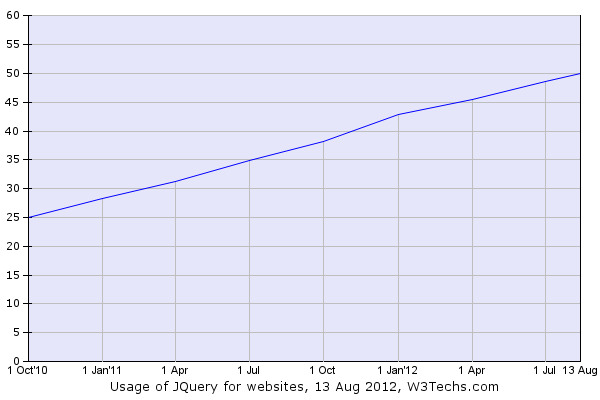
jQuery now runs on every second websitePosted by Matthias Gelbmann on 13 August 2012 in News, JavaScript Libraries, JQueryJohn Resig wrote a blog post about "Selectors in Javascript" in 2005, describing an idea on how to manipulate HTML elements by using JavaScript. When he finished that post with "more coming very soon", he might not have envisioned how much more there would actually come.
Only seven years after that initial idea, the jQuery library now runs on every second website. An incredible achievement. In the last year, every 4 minutes one of the top 1 million sites started to use jQuery. It was the fastest growing web technology in 2011, and there is no sign of a saturation yet. When we compare this with other technologies that enable webmasters to build interactive websites, we see for example Flash at 23.1% usage rate and Silverlight at 0.3%. That shows that "Selectors in Javascript" are probably not a bad idea. There are, of course, other JavaScript libraries that in many ways compete with jQuery. Other libraries offer different concepts and functionality, but the 88.3% market share of jQuery seems to indicate that jQuery delivers what many webmasters need. Many sites use more than one JavaScript library. One interesting fact is, that sites that use other popular libraries very often use jQuery as well. 49.5% of MooTools sites use jQuery and 49.2% of Prototype sites do. That is almost the same as the overall jQuery usage rate. The fact that a site uses MooTools or Prototype does not reduce the likelihood that is uses jQuery, as if there were no overlapping functionality. Sites that change from one JavaScript library to another tend to switch to jQuery, see our technology change survey. jQuery is used even more amongst the top 10,000 sites, with 58.8% usage rate, a bit less again amongst the top 1,000 sites with "only" 46.2%. Zimbabwe, Mozambique and Yemen are remarkable in that they are the only countries where jQuery is not the most popular library. jQuery has also a relatively low usage rate in China (33.5%) and Japan (42.9%). The highest usage rates are in Macedonia (71.4%), Ireland (65.1%), Australia (64.7%) and amongst .edu sites (71.5%). Another interesting finding of our surveys is the fact that jQuery sites are not overly keen on using the jQuery content delivery network. 73.4% of them don't use any CDN, and 94.2% of the rest use the Google Libraries API. Congratulations to John Resig and the jQuery community. I think it is not too much to say that you have significantly contributed to change the way the web works today. _________________ Share this page |
 LinkedIn
 Mastodon
 Bluesky